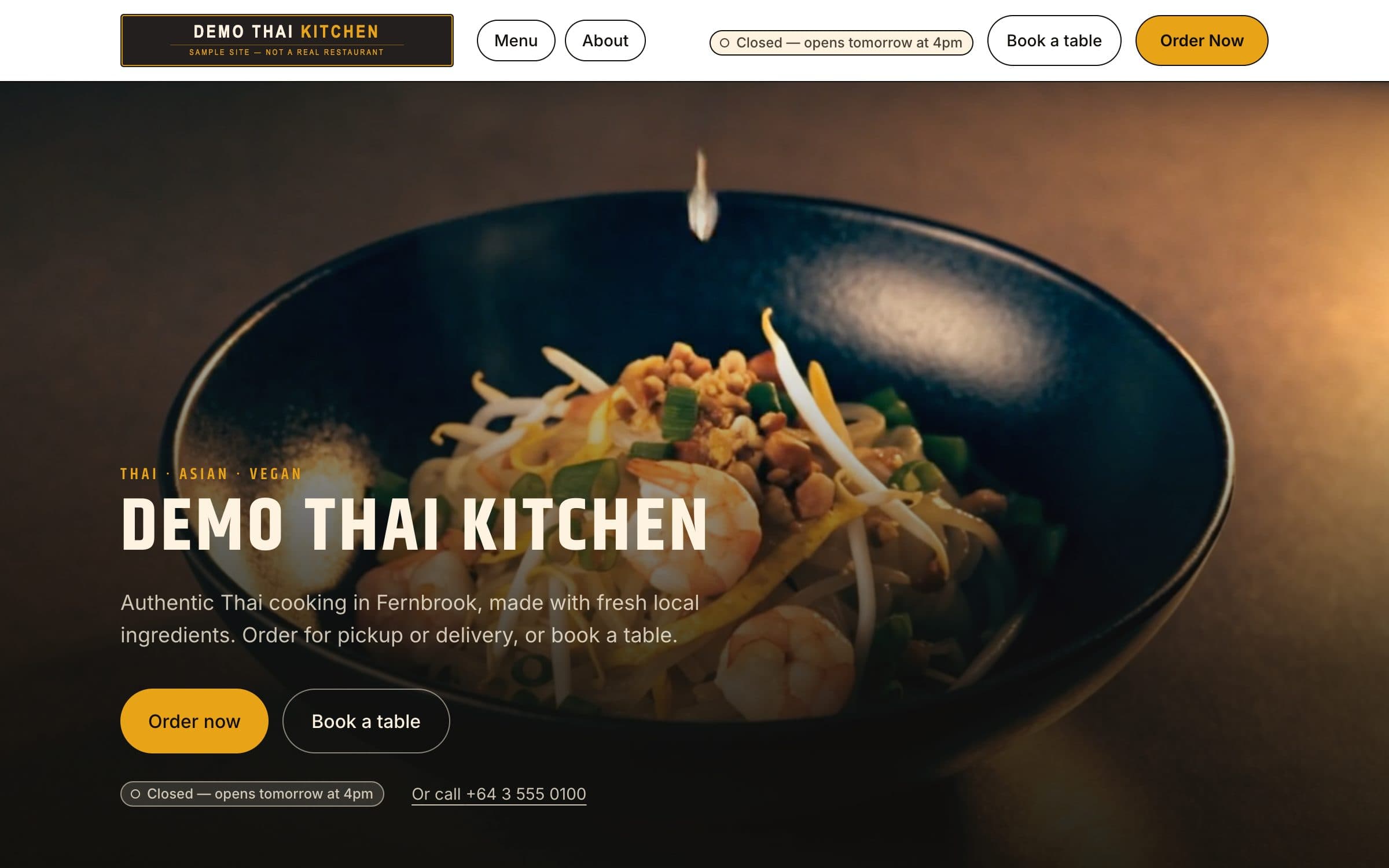
Online ordering, delivery and table bookings, run by the owner.

Your own ordering system, on your own site, keeping the commission a delivery platform would take.
A restaurant that takes orders through a third-party platform hands over 25–30% of every order, and along with it the customer's name, their address and their order history. On a busy month that is somebody's wage.
An ordering system on your own site changes the arithmetic. The customer orders from you, pays you, and is your customer afterwards. The platforms are still worth being on for reach — but they should not be the only way to buy from you.
The half a customer sees is a menu and a checkout, and any agency can build that. The half that is worth paying for is the one the owner uses during service: orders landing mid-shift, the menu, the hours, the delivery map, the bookings, and what actually sold last month. There is a working demonstration of exactly that below, and you can sign in to it and break it.
A new order alarms on the counter tablet, keeps the screen awake, and cannot be dismissed without a decision — because an order nobody noticed is a customer charged for food that was never cooked.
Add a dish, change a price, mark something sold out at seven on a Friday. Priced options — prawn adds $3, a fried egg adds $2 — with the total worked out on the server, because a price the browser sends is a price a customer can edit.
Opening hours per day, plus the specific dates you are closing. Closing next Sunday is a form you fill in, not a phone call to a developer.
Which suburbs you deliver to, what each one costs, and the minimum order for each — matched against the address the customer actually picked, so a quote is never a guess.
Bookings taken online and bookings taken over the phone on the same sheet, so what is in front of the host is the whole room rather than the half that came through the website.
Revenue and order counts over any range you ask for, top dishes, exported to CSV for the accountant.
Not a mockup and not a list of logos — the systems described above, running, with a way in.
No, and you probably should not. They bring reach you would not otherwise get. The point is to stop them being the only way to order from you, so the customers who already know you can buy direct at full margin.
Yes. The demonstration above signs you in as the manager in one click. Change the menu, reject an order, close next Sunday — it is invented data under an invented name, and it puts itself back every night.
Card payments are taken on your site and settle to your account. The order total is calculated on the server rather than trusted from the browser.
The bookings screen exists for exactly that reason — phone bookings and online bookings live on the same sheet. A system that only knows about half your business is worse than no system.
The rest of the work